



BY  GENN
GENN
2026/07
Blog
NM400 vs AR400 Steel: How to Choose the Right Abrasion-Resistant Steel Plate for Your Project?
In mining, construction machinery, heavy equipment, and industrial applications, equipment is constantly exposed to abrasion caused by hard materials such as ores, rocks, coal, and sand. Ordinary carbon steel plates can quickly suffer from wear, deformation, and reduced service life, resulting in frequent maintenance and increased operating costs. Therefore, more and more companies are choosing wear-resistant steel plates to improve equipment durability and reduce long-term maintenance expenses.
Among various abrasion-resistant steel products, NM400 wear-resistant steel plate and AR400 abrasion-resistant steel plate are two widely used 400-class wear-resistant steels. Both materials offer high hardness of approximately 400 HBW and excellent resistance to abrasion and impact. However, they differ in production standards, chemical composition, mechanical properties, and market applications.
For mining equipment manufacturers, engineering contractors, and steel buyers, selecting the right wear-resistant steel plate requires more than simply comparing hardness values. Factors such as working environment, processing requirements, procurement costs, and service life must also be considered. Understanding the differences between NM400 and AR400 steel plates helps companies choose a more economical and reliable material solution.
What Is NM400 Wear Resistant Steel Plate?
NM400 is a high-strength wear-resistant steel plate. The letter “NM” represents “Nai Mo” (wear-resistant in Chinese), while “400” indicates its Brinell hardness grade. NM400 is produced through optimized alloy design and quenching and tempering heat treatment, which provides high hardness, excellent strength, and good impact toughness.
The typical hardness range of NM400 is:
370-430 HBW
Due to its excellent abrasion resistance, NM400 can maintain stable performance under continuous wear conditions and significantly reduce the replacement frequency of equipment components.
NM400 wear-resistant steel plates are widely used in:
- Mining machinery
- Construction equipment
- Transportation equipment
- Crushing machinery
- Industrial wear liners
For example, in ore conveying systems, NM400 can effectively resist continuous impact and abrasion from mineral particles, extending equipment operating time.
What Is AR400 Wear Resistant Steel Plate?
AR400 is a widely used abrasion-resistant steel plate in the North American market. The abbreviation “AR” stands for Abrasion Resistant, while “400” represents the hardness grade.
AR400 generally has a hardness range of:
360-440 HBW
AR400 achieves excellent wear resistance through alloy strengthening and heat treatment processes. It is commonly used in industrial environments where equipment is exposed to continuous abrasion and impact.
Typical applications include:
- Mining truck bodies
- Quarry equipment
- Conveyor systems
- Hoppers
- Industrial wear liners
Due to its long history of application in North America, AR400 has gained strong recognition in engineering projects across the United States and Canada.
NM400 vs AR400 Steel Plate: Main Differences
Although NM400 and AR400 are both 400-grade wear-resistant steel plates, they are not exactly the same material. Their main differences include production standards, material design, and application markets.
1. Different Standards and Market Applications
The biggest difference between NM400 and AR400 is their standard systems.
NM400 is mainly produced under the Chinese wear-resistant steel system, commonly following:
GB/T 24186
and related standards.
Key features:
- Mature supply chain in China;
- Wide range of available specifications;
- Suitable for large-volume procurement;
- Competitive cost performance.
AR400 is mainly used in the North American abrasion-resistant steel market and is produced according to steel mill specifications commonly adopted in the region.
Key features:
- High recognition in North American markets;
- Suitable for local engineering procurement requirements;
- Commonly used in projects requiring AR grades.
| Item | NM400 | AR400 |
|---|---|---|
| Steel Type | Wear Resistant Steel Plate | Abrasion Resistant Steel Plate |
| Hardness Grade | 400 HBW Class | 400 HBW Class |
| Main Market | China, Asia, Export Projects | North America |
| Standard System | Chinese Standard System | North American Industrial System |
2. Hardness and Wear Resistance Comparison
Hardness is one of the most important indicators of wear-resistant steel performance.
NM400:
- Hardness: 370-430 HBW
AR400:
- Hardness: 360-440 HBW
From the hardness range, both materials are very close and provide similar wear resistance in most abrasion conditions.
However, wear resistance is not determined by hardness alone. It is also affected by:
- Chemical composition;
- Heat treatment process;
- Microstructure;
- Impact conditions.
For example, mining crushers require not only high hardness but also good impact toughness. Otherwise, the steel plate may crack under repeated impact loads.
Therefore, material selection should consider actual working conditions rather than hardness values alone.
3. Chemical Composition Comparison
Both NM400 and AR400 are low-alloy wear-resistant steels. Alloying elements are added to improve hardness, strength, and toughness.
Typical Chemical Composition of NM400
| Element | Content (%) |
|---|---|
| C | ≤0.30 |
| Si | ≤0.80 |
| Mn | ≤1.70 |
| P | ≤0.025 |
| S | ≤0.010 |
| Cr | ≤1.00 |
| Ni | ≤0.80 |
| Mo | ≤0.50 |
The functions of alloying elements in NM400:
- Carbon (C): Improves hardness and wear resistance.
- Manganese (Mn): Enhances strength and hardenability.
- Chromium (Cr): Improves abrasion resistance.
- Nickel (Ni) and Molybdenum (Mo): Improve toughness and impact resistance.
Typical Chemical Composition of AR400
| Element | Content (%) |
|---|---|
| C | 0.20-0.30 |
| Si | ≤0.80 |
| Mn | 1.00-1.50 |
| Cr | 0.50-1.00 |
| Ni | Adjusted by manufacturer |
| Mo | Adjusted by manufacturer |
The chemical composition of AR400 is usually adjusted by different steel mills according to their own production technologies and performance requirements.
4. Mechanical Properties Comparison
| Property | NM400 | AR400 |
|---|---|---|
| Hardness | 370-430 HBW | 360-440 HBW |
| Yield Strength | ≥1000 MPa | Around 1000 MPa |
| Tensile Strength | 1250-1450 MPa | ≥1250 MPa |
| Elongation | ≥10% | Around 8-12% |
NM400 mainly focuses on:
- High strength;
- Balanced hardness and toughness;
- Comprehensive mechanical performance.
AR400 mainly focuses on:
- Stable abrasion resistance;
- Proven industrial applications;
- Standardized manufacturing.
5. Processing Performance Comparison
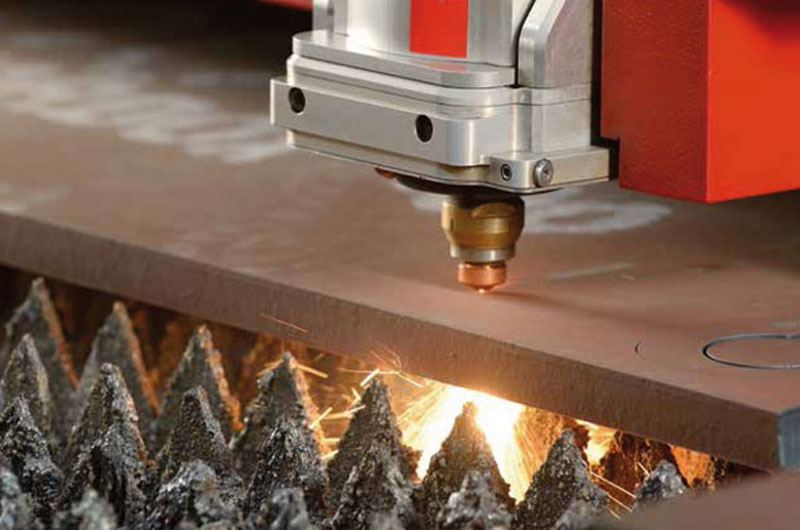
Due to their high hardness, both NM400 and AR400 require professional processing methods.
Both materials can be processed by:
- Laser cutting
- Flame cutting
- Plasma cutting
- Drilling
- Welding
- Bending
During fabrication, attention should be paid to:
- Cutting heat input control;
- Avoiding cracks in the heat-affected zone;
- Adjusting welding parameters according to plate thickness.
For complex components such as excavator buckets, mining truck bodies, and crusher liners, choosing a supplier with experience in wear-resistant steel processing is highly recommended.
Applications of NM400 and AR400 Wear Resistant Steel Plate
NM400 Applications
NM400 is widely used in:
Mining Equipment
- Crusher liners
- Vibrating screen plates
- Ore chutes
- Hoppers
Construction Machinery
- Excavator buckets
- Loader buckets
- Bulldozer blades
Heavy Transportation Equipment
- Dump truck bodies
- Mining truck floors
- Wear-resistant structural components
AR400 Applications
AR400 is commonly used in:
Mining Industry
- Mining trucks
- Crushing equipment
- Screening equipment
Industrial Equipment
- Conveyor systems
- Storage bins
- Wear liners
Agricultural Equipment
- Grain handling equipment
- Agricultural machinery components
When Should You Choose NM400 or AR400?
The choice between NM400 and AR400 depends on project requirements and operating conditions.
Choose NM400 When:
NM400 is more suitable when:
✔ Cost control is an important consideration;
✔ Large-volume supply is required;
✔ Customized processing services are needed;
✔ Projects use Chinese steel supply chains;
✔ Applications involve mining and construction machinery.
Choose AR400 When:
AR400 is more suitable when:
✔ The project is located in North America;
✔ The customer specifies AR400 grade;
✔ Local procurement standards must be followed;
✔ Existing equipment uses AR-series materials.
NM400 Wear Resistant Steel Plate Supply and Services
As a professional wear-resistant steel supplier, we provide not only NM400 steel plates but also complete solutions according to customer project requirements.
1. Customized Sizes
We can supply:
- Different thicknesses of NM400 steel plates;
- Cut-to-length plates;
- Large-size steel plates;
- Customized specifications.
2. Processing Services
Available services include:
- CNC cutting;
- Laser cutting;
- Flame cutting;
- Drilling;
- Welding fabrication.
These services help customers reduce on-site processing costs and improve production efficiency.
3. Quality Inspection
Each batch of NM400 wear-resistant steel plate can be supplied with:
- Chemical composition testing;
- Hardness testing;
- Mechanical property testing;
- Ultrasonic testing;
- Mill Test Certificate (MTC).
This ensures the material meets project quality requirements.
NM400 and AR400 are both high-performance wear-resistant steel plates designed to solve severe abrasion problems in mining, construction machinery, and heavy industrial applications.
The main difference between them is not their basic wear resistance, but rather their standard systems, market recognition, and procurement requirements. NM400 offers excellent cost efficiency and flexible supply options for many international industrial projects, while AR400 is often preferred for North American projects or applications requiring specific AR grades.
When selecting a wear-resistant steel plate, companies should consider abrasion level, impact conditions, processing requirements, supply channels, and long-term operating costs. Choosing the right material can significantly extend equipment service life and reduce maintenance expenses.